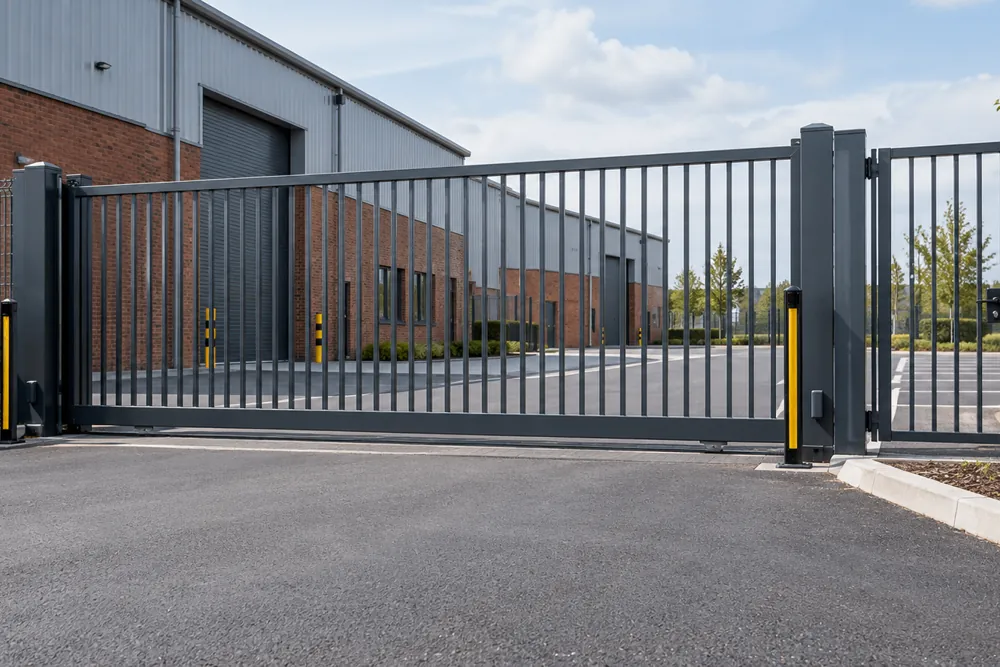
A Gate Is A Moving Machine
Automatic gates can control vehicle entry to commercial premises, but the complete installation needs a safety-led design. The gate leaf, drive, controls, protective devices and surrounding structure work together. A motor added to an existing gate does not automatically create a safe powered gate.
We consider how vehicles, pedestrians, delivery drivers and staff move around the entrance. A sliding gate may suit one layout, while a swing gate may suit another. Space, gradients, wind exposure, traffic patterns and access to a separate pedestrian route should inform the selection before the equipment is specified.
Entrapment points are not limited to the closing edge. Hinges, gaps behind a sliding leaf, posts, fixed fencing and drive mechanisms can create hazards. The assessment must consider foreseeable use and misuse, including people who are unfamiliar with the entrance, rather than assuming everyone follows the same staff instructions.
Survey, Design And Installation
The survey should record the opening dimensions, supporting structure, ground conditions, available power and the space needed for safe movement. Identify emergency access arrangements and how a vehicle can wait without obstructing other routes. Any civil works or changes to drainage should be included in the project scope.
The design needs a documented risk assessment with protective measures matched to the hazards. That can involve guarding, safety edges, sensors and an appropriate control mode. No single protective device should be treated as a substitute for assessment of the whole installation and its operating environment.
Installation includes the physical gate, drive, controls and required safety equipment, followed by commissioning and relevant testing. The handover should cover normal operation, emergency release, isolation and the checks expected of the responsible person. Keep the technical and conformity documentation with the premises records so it is available to future maintainers.
UK Powered Gate Requirements
HSE explains that powered gates first supplied or put into service are subject to the Supply of Machinery (Safety) Regulations 2008. The complete product needs the relevant conformity documentation, instructions and marking. HSE’s powered gate guidance also addresses ongoing responsibilities at workplaces.
The Workplace (Health, Safety and Welfare) Regulations 1992 include provisions on maintenance and door and gate safety. PUWER may also apply where the installation is work equipment. BS EN 12453 is a relevant powered gate safety reference, but applying a standard does not remove the need to address site-specific hazards.
A dangerous gate should be taken out of use and made safe while competent advice is obtained. Do not bypass protective devices to keep a faulty entrance moving. Tell your facilities contact when safety equipment is damaged, the gate behaves unexpectedly or the physical surroundings change.
Access Methods And Maintenance
Access technology can include fobs, an intercom or an agreed vehicle identification method. Choose it around how permission is granted and removed, who answers visitor calls and what happens during a fault. Automatic opening is a convenience feature only when the underlying movement and protective measures remain suitable.
Planned maintenance should follow the manufacturer instructions and the risk assessment. Records should cover defects, adjustments, protective device checks and relevant tests. Changes to fencing, kerbs or the use of the entrance may alter the risks even if the gate itself has not been modified.
Staff need a clear way to report problems and restrict use when required. Emergency release instructions should be available to authorised people, with practical training where appropriate. A lost remote control, collision or damaged edge should trigger a review of the affected function before normal use resumes.
What Affects Automatic Gate Cost?
Gate size, material, supporting structure, drive system and safety measures all affect the proposal. Groundworks, power provision, ducting, drainage and traffic management can be significant parts of a commercial project. A proper quotation should distinguish these from access readers, intercom equipment and ongoing maintenance.
For an existing entrance, provide photographs and a description of the fault without entering a danger zone. The first visit may need to establish condition and documentation before a repair or automation proposal is possible. Retaining an unsuitable leaf or support structure can limit what can safely be achieved.
For connected staff entrances, see access control systems and door entry systems. Share your site’s vehicle and pedestrian arrangements when you request an automatic gate proposal, so the entrance can be reviewed as a complete working area.
Your Questions Answered
Can Existing Commercial Gates Be Automated?
Existing commercial gates can sometimes be automated after a competent assessment of their structure, condition and surroundings. The project must address hazards created by powered movement and the requirements for the complete machine. A replacement gate or altered layout may be needed if the existing arrangement cannot be made suitable.
What Should We Do If A Gate Safety Device Fails?
A gate safety device fault needs prompt assessment by a competent contractor. Keep people away from the hazard and take the gate out of use where its safety is in doubt, following the premises isolation procedure. Do not bridge out sensors or force the gate to operate while waiting for advice.